
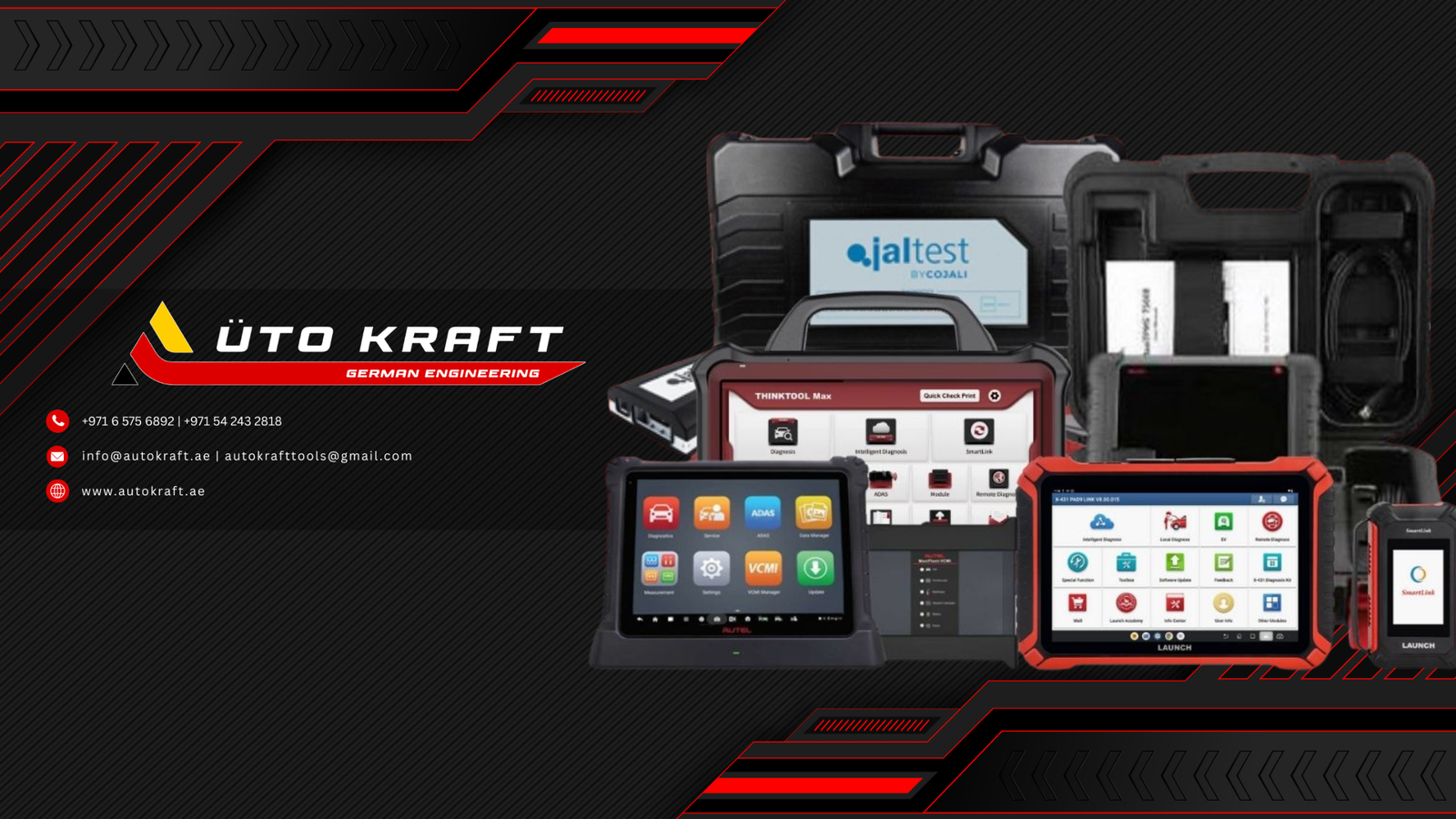
Best Car Diagnostic Scanners in UAE and GCC 2026
Car diagnostic scanners are now essential for workshops, garages, and serious car owners in the UAE. With modern vehicles depending on ECUs, sensors, and advanced electronics, the right scanner can save time, reduce misdiagnosis, and improve repair accuracy.
Whether you run a workshop in Dubai, manage a garage in Sharjah, or want a reliable scanner for personal use, choosing the right diagnostic tool matters. In this guide, we’ll break down the best scanner types, what features to look for, and how to choose the right option for your needs.
Why diagnostic scanners matter
A diagnostic scanner helps read fault codes from a vehicle’s computer system. It can identify engine issues, transmission faults, ABS errors, airbag warnings, battery problems, and many other hidden issues.
Instead of guessing, technicians can use live data, fault code readings, and system tests to find the real problem faster. That means better repairs, lower labor time, and happier customers.
In the UAE, this is especially important because many vehicles face heavy daily use, high temperatures, and long-distance driving. These conditions can make sensors, batteries, cooling systems, and electronic components work harder than usual.
Types of diagnostic scanners
Not every scanner is the same. Some are designed for basic code reading, while others are built for professional workshop use.
These are entry-level tools that can read and clear engine fault codes. They are suitable for car owners or small garages that need simple diagnostics.
They are usually affordable and easy to use, but they do not always support advanced functions like ABS, transmission, or ECU coding.
Full-system scanners can access multiple vehicle modules, not just the engine. They are better for professional garages that need deeper diagnosis across ABS, SRS, transmission, steering, and air conditioning systems.
These scanners are a stronger choice if you want to handle a wider range of repairs and vehicle brands.
Bi-directional scanners
Bi-directional scanners allow the technician to send commands to the vehicle. This means you can test components, activate systems, and perform certain functional checks without removing parts.
For workshops, this is one of the most useful features because it improves speed and accuracy.
Some diagnostic tools are built for specific car brands such as BMW, Mercedes-Benz, Toyota, Nissan, or Volkswagen. These can be very useful if your workshop mainly handles one make or a narrow group of vehicles.
They often offer stronger compatibility and more advanced functions for that brand.
What to look for
Before buying a scanner, it helps to compare features carefully. A scanner that looks powerful on paper may not be the right fit for your actual work.
Vehicle coverage
Check whether the scanner supports the brands and models you service most often. UAE workshops usually handle a wide mix of Japanese, German, Korean, and American vehicles.
If you serve fleet customers or luxury car owners, broad compatibility becomes even more important.
System coverage
A strong scanner should do more than basic engine code reading. Look for support for ABS, SRS, transmission, airbag, steering, body control, and other essential modules.
More system coverage means fewer limitations in daily workshop work.
Live data and graphing
Live data shows how sensors and systems behave in real time. This makes it easier to identify faults that may not appear as a permanent code.
Graphing features are especially useful when diagnosing intermittent issues or comparing readings between systems.
Special functions
Advanced scanners may include features such as service reset, oil reset, brake reset, battery registration, injector coding, throttle adaptation, EPB service, DPF regeneration, and more.
These functions can save time and help workshops offer more complete services.
Update support
Always check whether the scanner includes software updates. Vehicle technology changes constantly, so regular updates are important for long-term use.
A scanner with poor update support may become outdated quickly.
Ease of use
Touchscreen navigation, clear menus, and fast boot-up time can make a big difference in a workshop. A tool that is simple to use can improve productivity and reduce training time.
If multiple technicians will use it, the interface should be straightforward.
Choosing by use case
The best scanner depends on how you plan to use it. A personal user and a busy garage will not need the same features.
For car owners
If you only want to check warning lights and read basic fault codes, an entry-level OBD2 scanner is usually enough. It gives a quick view of engine-related issues and is easy to store in the car.
This is a good option for simple maintenance and troubleshooting.
For small garages
A full-system scanner is a better choice for small garages. It provides more coverage and helps diagnose multiple systems across different car brands.
This type of scanner gives a much better return on investment if you work on a variety of vehicles.
For professional workshops
Professional workshops should look at bi-directional scanners with advanced service functions. These tools can handle deeper diagnostics, functional tests, and more complex repair jobs.
If your workshop handles premium or European vehicles, this level of scanner is usually worth the investment.
For mobile mechanics
Mobile mechanics need a scanner that is portable, reliable, and fast. A compact tablet-style diagnostic tool with wide vehicle support is often the best fit.
Battery life, wireless connection, and easy updates matter a lot for mobile use.
Common UAE workshop needs
Many garages in the UAE deal with similar diagnostic problems again and again. These often include battery-related faults, AC system issues, sensor errors, transmission warnings, and ABS problems.
Because of the climate, cooling systems and electrical components often need extra attention. That makes a scanner with strong live data and multi-system support especially useful.
Workshops also need tools that can handle a wide range of cars from different markets. A scanner that supports GCC, Japanese, European, and American vehicles gives you better coverage.
Best scanner features for workshops
If you are buying for workshop use, focus on features that improve speed and service quality.
- Multi-brand compatibility.
- Full-system diagnosis.
- Bi-directional control.
- Service reset functions.
- ECU reading and clearing.
- Live data recording.
- Software update support.
- Strong after-sales assistance.
- Arabic-friendly or easy-to-understand interface where possible.
These features help workshops work faster and reduce the chance of incorrect diagnosis.
Scanner price guide
Pricing depends on brand, vehicle coverage, and diagnostic depth. Basic scanners are usually the most affordable, while professional systems cost more because they offer advanced functions.
A simple rule is this: the more vehicles and systems you need to cover, the more you should invest. A cheap scanner may work for basic code reading, but it can become a limitation if your workshop grows.
Instead of buying the lowest-priced tool, choose the scanner that matches your daily workload and the type of cars you service.
How to compare options
When comparing scanners, ask these questions:
- Does it support the vehicles I service most?
- Does it read only engine codes, or full systems?
- Can it perform special functions?
- Does it offer software updates?
- Is support available if I need help?
- Is it fast enough for workshop use?
- Does it offer good value over time?
If the answer to most of these is yes, the scanner is likely a solid choice.
AutoKraft UAE focuses on reliable automotive tools for workshops and professionals who need practical results. Instead of choosing random products, you get tools selected for real workshop use and UAE market needs.
That means better guidance, better product suitability, and a smoother buying experience. If you are comparing diagnostic scanners for your garage, AutoKraft can help you choose the right option based on your vehicle types and service requirements.