
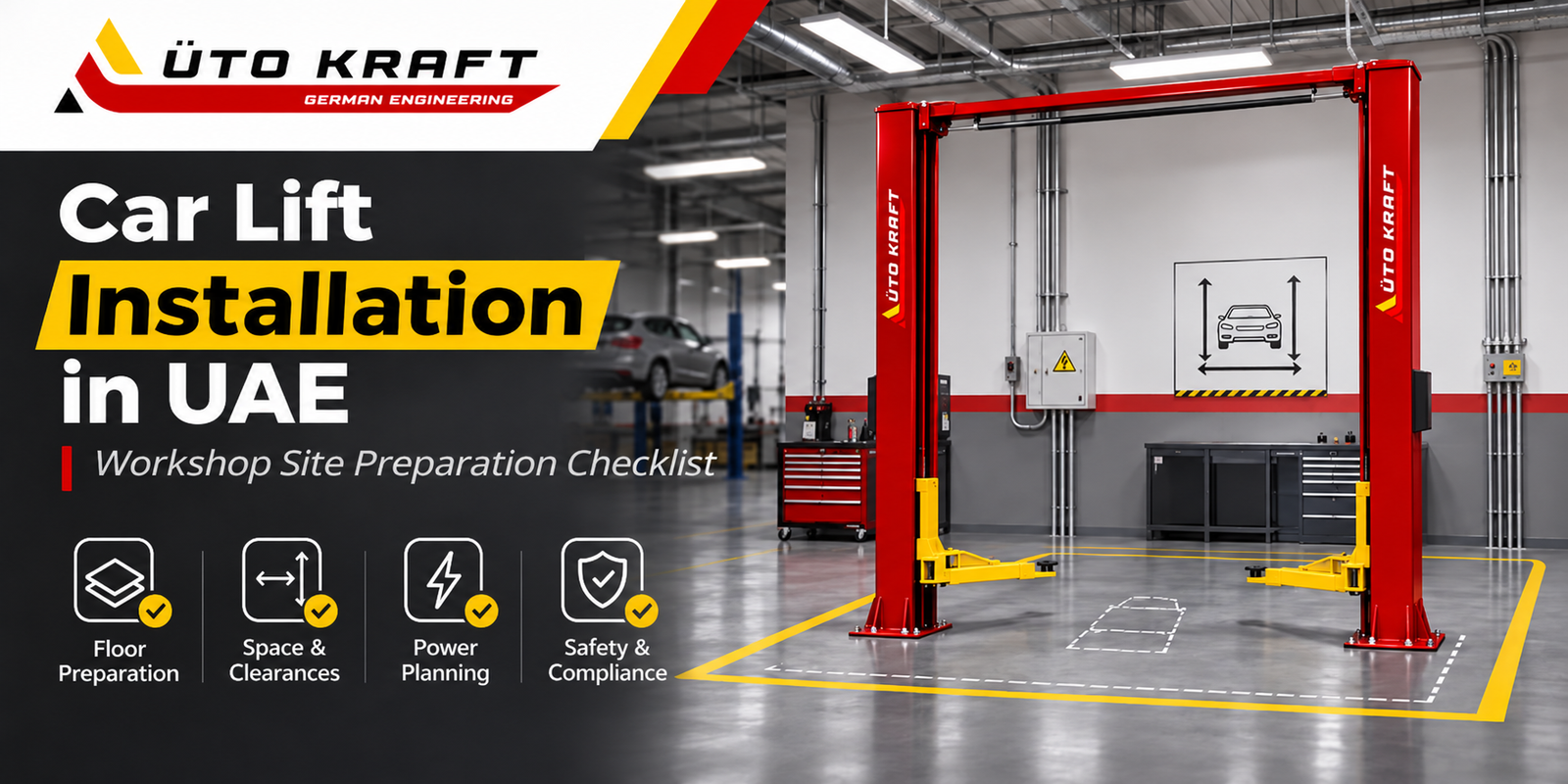
Successful car lift installation begins before the equipment arrives. A garage needs a suitable service bay, appropriate structural conditions, the correct utilities and a clear installation scope. Planning these items early can reduce avoidable delays and help the installer complete the work according to the selected equipment’s instructions.
This checklist is for workshop owners planning vehicle lift installation in the UAE. It is a site-readiness guide, not a substitute for a manufacturer’s installation manual or professional engineering assessment.
1. Confirm the exact lift model and documentation
Identify the precise model and variant to be installed. Different two-post, scissor and other lift systems can have different foundation details, dimensions, motor requirements and operating clearances—even where lifting capacities appear similar.
Ask for the installation drawing, technical data, operating manual and any required pre-installation checks. Do not plan anchor positions or floor modifications using specifications from a different model.
2. Measure the service bay accurately
Measure the available floor length and width, clear ceiling height, vehicle entry route, nearby columns and distance from other equipment. Account for the vehicles when raised, not only the lift at rest.
• Service-bay dimensions and floor plan
• Ceiling beams, ducts, suspended lights and other overhead obstructions
• Vehicle turning and approach routes
• Clearance for opening doors and technician access
• Access required for maintenance and emergency movement
Provide the measured layout to the equipment supplier before approving the installation position.
3. Have the floor and foundation assessed
Floor suitability is critical. Some lifts require specified anchors in suitable concrete; other designs may need recessed pits or dedicated civil work. A qualified professional should compare the actual slab, reinforcement, condition and any site constraints with the manufacturer’s requirements.
Visible concrete is not evidence that the foundation is suitable. Avoid drilling or placing anchors until the necessary assessment and plans are complete.
4. Review electrical and utility requirements
Many hydraulic vehicle lifts use electrical power. Confirm the required supply, protection, isolation, wiring route and any other utilities before installation. The manufacturer’s specifications—not assumptions based on another machine—must guide this work.
Use qualified personnel for electrical work and keep the relevant installation documentation available.
5. Prepare delivery and unloading access
Lift columns, runways or platforms can be large and heavy. Confirm where the delivery vehicle will stop, how components will pass through site openings and who provides unloading arrangements.
If the garage remains operational, agree on a cordoned-off working area and remove vehicles and movable equipment ahead of installation.
6. Clarify who is responsible for each part of the job
An equipment quotation may not include every on-site activity. Confirm responsibility for surveys, civil works, foundations, electrical preparation, unloading, assembly, commissioning and operator handover.
Ask the supplier to distinguish included services from items the workshop must arrange. Written allocation of responsibilities prevents disagreements on installation day.
7. Plan commissioning and operator handover
Assembly does not automatically make a lift ready for use. Appropriate personnel must perform installation checks, prescribed functional and safety tests and any inspections required by applicable rules and the manufacturer.
Operators need instruction on approved vehicle positions, load limits, controls, safety devices and reporting malfunctions. Keep installation and maintenance records where the workshop team can find them.
8. Keep a practical site-readiness record
Create a short file containing the model, bay measurements, drawings, floor assessment, electrical details, delivery plan and installation scope. Record the commissioning and handover once completed.
This documentation helps future technicians understand the equipment and can support maintenance planning.
9. Discuss installation requirements with AUTO KRAFT
AUTO KRAFT supplies automotive lifting equipment for UAE workshops, including different two-post and scissor lift models. For example, its AK4500BS is listed as a 4,500 kg base-plate two-post lift. Site and vehicle suitability must still be assessed against the manufacturer’s instructions.
Browse the relevant Hydraulic Lift category and share your workshop drawings, vehicle types and location to discuss suitable equipment and installation scope.
Frequently Asked Questions
Can a car lift be installed on any concrete floor?
No. The floor and foundation must be assessed against the exact model’s requirements.
What measurements do installers need?
They usually need service-bay dimensions, clear height, vehicle access information and relevant site drawings, plus any model-specific information.
Who should prepare the electrical connection?
Qualified personnel should prepare and connect the supply according to the equipment documentation and applicable requirements.
Should the workshop operate the lift immediately after assembly?
No. Required commissioning, tests, inspection and operator handover must be completed first.
What should I provide when requesting an installation quotation?
Share the preferred lift type, vehicle types, workshop location, floor plan and available utilities. Ask for the full scope of included site work.
Get ready for your new workshop lift
Planning a garage upgrade? Email sales@autokraft.ae or call +971 6 575 6892 to discuss AUTO KRAFT lifting equipment and installation requirements. Explore the Hydraulic Lift category below.